 Issue to Code
 Architecture
How the moving parts fit together and which job each one does.
Stack at a glance
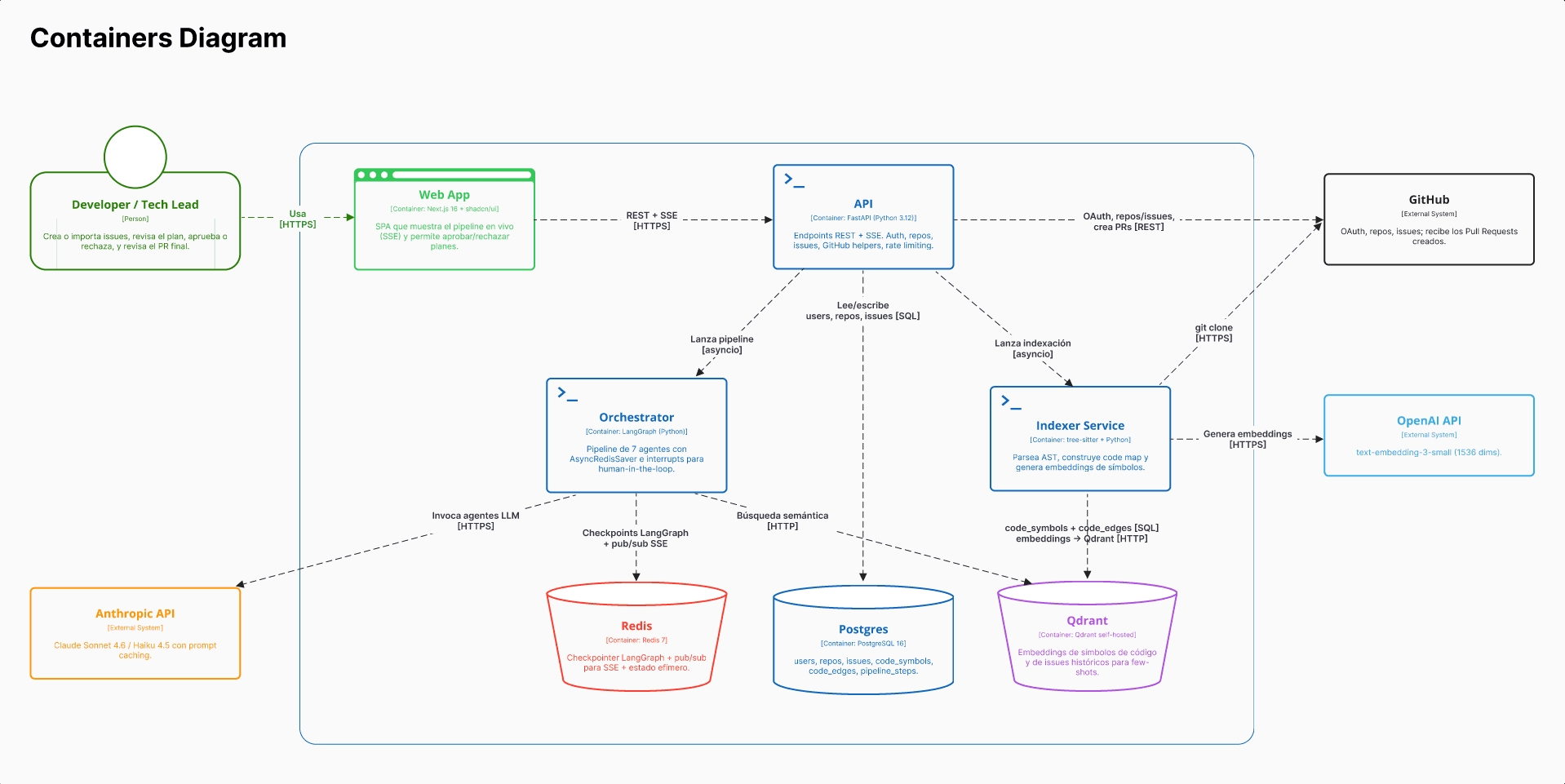
- Backend — FastAPI (Python 3.12+) exposing REST endpoints and two SSE streams. LangGraph drives the seven-agent pipeline with a Redis checkpointer.
- Frontend — Next.js 16 (App Router) + TypeScript. The Issue detail view consumes the pipeline SSE to render the run in real time.
- PostgreSQL — durable business data: users, repositories, issues, pipeline steps and the structural code map (symbols + edges).
- Redis — LangGraph checkpoints, SSE pub/sub channels, and a capped event-replay buffer.
- Qdrant — vector store: embeddings of code symbols and embeddings of past issues for the few-shot retriever.
- External APIs — Anthropic (Claude Sonnet 4.6 and Haiku 4.5), OpenAI (text-embedding-3-small) and GitHub (OAuth + REST).
C4 Level 2 Diagram
What the indexer does
When the user adds a repository, the indexer clones it shallowly, parses every supported file with tree-sitter and extracts structural information at the symbol level (functions, classes, components). It builds a code map in Postgres (code_symbols, code_edges) and generates one embedding per symbol in Qdrant. The temporary clone is removed as soon as the run finishes — we never persist source code.
The Locator later combines semantic search (top-K in Qdrant) with a graph expansion (callers, callees, same-file siblings) so it can return both lexically similar code and code that is contextually relevant.
Multi-tenant isolation
Every query to Postgres and Qdrant is keyed by the authenticated user's id. Qdrant collections are named code_{user_id}_{repo_id} and issues_{user_id}; the service layer never exposes these names to the frontend. Postgres queries always filter by user_id at the service layer. Row-Level Security is not enabled in the MVP.